.png)
What the Latest Evidence Says About Regenerative Aesthetics
- Dr Adama Luca

- Mar 25
- 2 min read
Regenerative aesthetics is one of the fastest-growing areas in aesthetic medicine. Treatments such as polynucleotides, PRP, and exosome-based therapies are becoming increasingly popular, but there’s still a lot of confusion about what they actually do and how effective they are.
As an aesthetic doctor with a background in minimally invasive aesthetics, I always prioritise treatments that are supported by clinical evidence. Recently, several published studies have looked more closely at regenerative treatments, and the findings are worth understanding if you’re considering these options.
What is regenerative aesthetics?
Regenerative treatments focus on improving skin quality by stimulating the body’s own repair processes rather than simply adding volume or freezing movement.
This includes:
Platelet-rich plasma (PRP)
Polynucleotides
Exosome-based therapies
Biostimulatory injectables
The goal is to improve:
Skin texture
Elasticity
Hydration
Overall skin health
What does the latest research show?
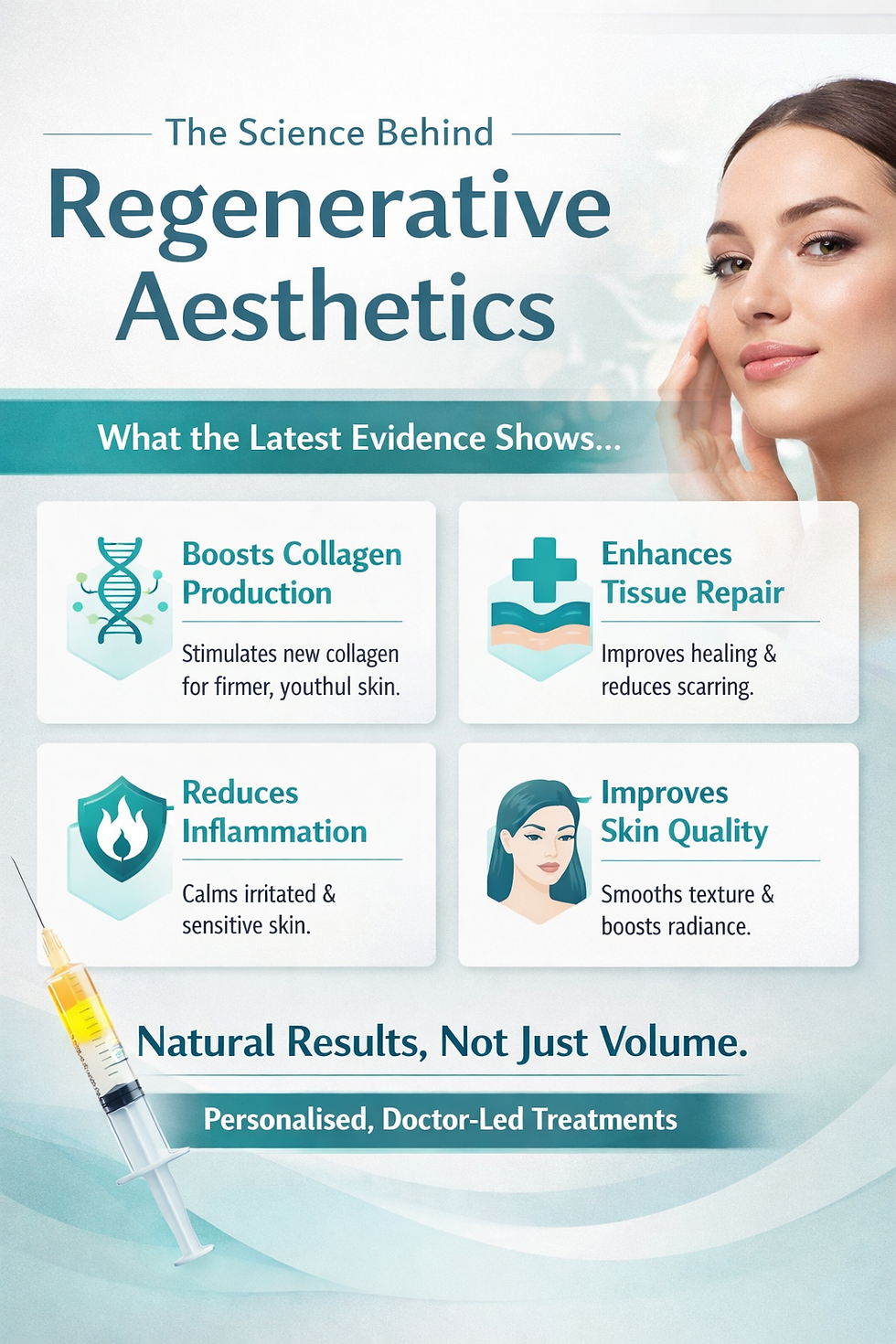
Recent clinical studies suggest that regenerative treatments can improve skin quality through several mechanisms:
1. Stimulation of collagen production
The evidence consistently shows that these treatments promote fibroblast activity, which is essential for collagen synthesis. This is important because collagen loss is one of the main drivers of visible ageing.
2. Improved tissue repair and healing
Some studies demonstrate that regenerative therapies enhance wound healing and tissue regeneration. This is particularly relevant for:
Acne scarring
Skin damage
Early signs of ageing
3. Anti-inflammatory effects
There is growing evidence that certain regenerative treatments can reduce inflammation in the skin. This may contribute to improvements in conditions such as:
Sensitive skin
Post-procedure recovery
Chronic low-grade skin inflammation
4. Improvement in skin quality rather than volume
Unlike dermal fillers, these treatments do not primarily add volume. Instead, they improve the underlying skin structure, which leads to a more natural and gradual result.
How strong is the evidence?
The studies available show promising results, but it’s important to be realistic.
Many studies are small or early-stage
Protocols vary significantly between practitioners
Long-term data is still developing
That said, the consistency in findings across different studies supports the role of regenerative treatments in improving skin quality.
Are these treatments suitable for everyone?
Not necessarily.
Regenerative treatments tend to work best for:
Early to moderate skin ageing
Patients looking for subtle, natural improvements
Those wanting to improve skin quality rather than change facial structure
They may be less suitable if you are looking for immediate or dramatic volume changes.
What this means in practice
In clinic, these treatments are often used as part of a wider treatment plan rather than in isolation.
For example:
Combined with microneedling to enhance delivery
Used alongside skin boosters or peels
Integrated into long-term skin health strategies
The key is selecting the right treatment for the right patient, based on clinical assessment.
Final thoughts
Regenerative aesthetics is an exciting area, and the science is evolving quickly. The current evidence supports its role in improving skin quality, but it’s important to approach it with realistic expectations.
If you’re considering these treatments, the most important step is a proper consultation. This allows us to assess your skin, understand your goals, and design a treatment plan that is both safe and evidence-based.


Comments